Best Electrical Infrastructure for Retail: 2026 Guide

Table of Contents
What Makes Retail Electrical Infrastructure Different
High-Density Loads and POS Power
The Cost of Downtime
Core Components of Modern Retail Electrical Infrastructure
Power Distribution and Panel Management
Conduit and Commercial Wiring Standards
NEC Electrical Code Compliance for Commercial Buildings
EV Charging Station Installation for Retail
The Load Math That Decides Whether You Can Install at All
Hardware and Network Choices
Where Modular and Pop-Up Retail Changes the Answer
Commercial Generator Maintenance for Small Businesses
The Maintenance Schedule That Actually Keeps a Generator Ready
The Compliance Checklist Retail Managers Miss
Why This Matters More for Small Retailers
Smart Building IoT Integration and Energy Management
Retrofitting vs. New Construction: What to Know
Conclusion: Building a Resilient Retail Power Strategy
Frequently Asked Questions
Last Updated: September 15, 2026
What Makes Retail Electrical Infrastructure Different
The best electrical infrastructure for retail is the interconnected system of panels, circuits, conduit, and control devices that delivers safe, continuous power to a store's point-of-sale terminals, lighting, refrigeration, and HVAC equipment. It differs from residential wiring because loads are denser, downtime costs more, and code requirements are stricter. This guide from Elecstroman Electric covers what matters when you specify, upgrade, or replace that infrastructure in 2026.
Two forces separate retail from every other commercial category: the load profile, since a single storefront might run POS terminals, digital signage, refrigerated cases, and a commercial kitchen on one service at once, and the stakes, when the lights go out, sales stop instantly.
High-Density Loads and POS Power
A modern checkout lane is not one circuit but a terminal, card reader, receipt printer, scale, and often a self-service kiosk, each with its own draw and sensitivity to power surges. Add refrigeration, HVAC, and LED signage, and a mid-size store can pull more current per square foot than a small office building.
That density is where load balancing earns its keep: electricians distribute circuits across phases so no single leg carries a disproportionate share of the electrical load. Done right, panels run cooler and last longer; done wrong, you get nuisance breaker trips during peak hours.
The Cost of Downtime
A power failure at a grocery store is not an inconvenience but a food-safety event. Refrigeration loss, spoiled inventory, and forced closures stack up fast, and the damage compounds with every hour the store stays dark. For retailers, backup power is continuity insurance, not a luxury.
Watch Out Skipping a load calculation before adding equipment is the single most common retail electrical mistake. A new freezer or EV charger dropped onto an already-loaded panel causes voltage sags that quietly damage POS hardware long before a breaker ever trips.
Core Components of Modern Retail Electrical Infrastructure
Retail power infrastructure comes down to four parts: the service entrance, the distribution panel, the branch circuitry, and the wiring that connects them. Get the panels and conduit right and everything downstream behaves predictably.
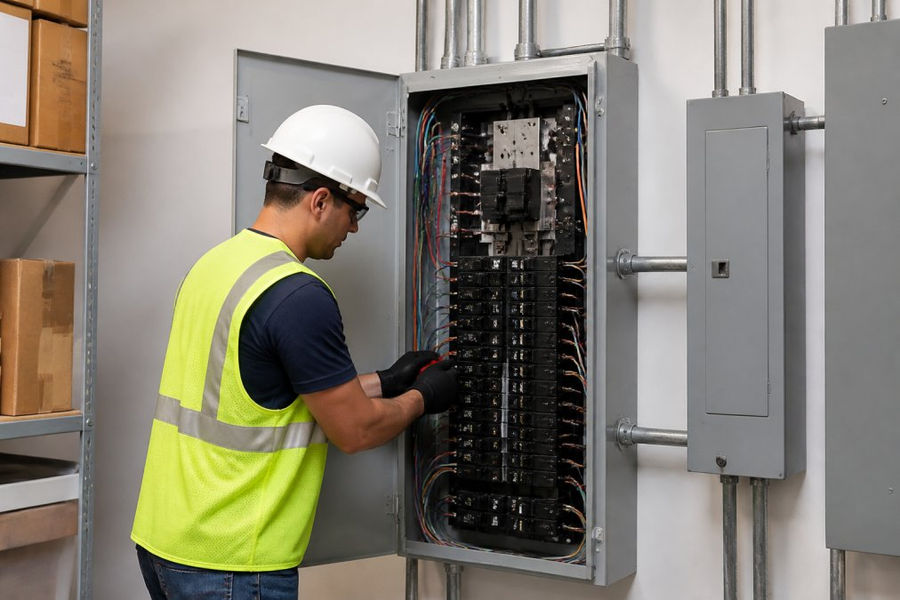
Power Distribution and Panel Management
Panel management means matching breaker capacity to actual demand while leaving room to grow. Retailers who treat the panel as a fixed asset pay for it later, when a remodel or new equipment line forces an emergency service upgrade.
Eaton Load Centers handle this well, with modular designs that support scalable expansion and compatibility with smart monitoring for real-time load analysis. Schneider Electric Square D panelboards remain a contractor favorite for new construction because replacement parts are easy to source. Siemens Sentron circuit protection suits high-density retail centers where arc fault and ground fault protection are non-negotiable, though it costs more than standard-grade components.
Component | Best For | Standout Feature |
Eaton Load Centers | Scalable retail expansions | Modular, smart-monitoring ready |
Schneider Electric Square D | New construction | Wide contractor support |
Siemens Sentron | High-density loads | Advanced arc fault protection |
Hubbell Wiring Device-Kellems | Sales-floor power access | Durable floor boxes |
Conduit and Commercial Wiring Standards
Conduit is the physical backbone of commercial wiring, and its sizing and routing decide how maintainable a store's electrical system will be years from now. Exposed conduit in back-of-house areas must be supported and grounded, and every run labeled at both ends.
Conduit planning is a floor-plan decision, not just an electrical one. Retailers who lock their fixture layout before the electrician routes conduit end up with power where the old layout needed it, not the new one.
NEC Electrical Code Compliance for Commercial Buildings
Compliance with the National Electrical Code is mandatory for every commercial retail build, and the requirements are updated on a three-year cycle through the National Fire Protection Association's NEC overview. Retailers who treat code as a one-time checkbox get failed inspections when a remodel triggers new requirements.
Build code review into every project phase, not just the final inspection: load calculations before equipment is ordered, conduit sizing before walls close, and emergency lighting verification before the certificate of occupancy is requested.
Pro Tip Photograph and label every panel directory the day it's installed. When a breaker trips two years later, a current directory turns a two-hour diagnostic into a five-minute fix, and inspectors notice the difference during re-inspections.
EV Charging Station Installation for Retail
EV charging installation for retail is now a customer-acquisition decision, not just a facilities one: shoppers who charge while they browse stay longer and spend more. The catch is electrical capacity, EV charging is the fastest way to blow past a retail service's spare capacity, because it is a continuous, high-amperage load unlike the intermittent loads a store was wired for.
The Load Math That Decides Whether You Can Install at All
A Level 2 commercial charger typically draws 32 to 48 amps at 208 or 240 volts, landing each unit in the 6.6 kW to 11.5 kW range depending on model and amperage setting (Alternative Fuels Data Center: Electric Vehicle Charging Stations). A single dual-port pedestal can pull as much as a small commercial kitchen. Before ordering hardware, a licensed electrician should run a load study answering three questions: the existing service size, the current connected load, and the spare capacity remaining after National Electrical Code demand factors are applied.
A common pattern: a store with a 400-amp, 208-volt three-phase service has headroom for one or two chargers but not four. The fix is usually derating the chargers to share available capacity, adding a load-management controller that sheds charging at peak, or upgrading the service. Each has a different cost and timeline, and the wrong choice shows up as nuisance trips on refrigeration circuits during a summer afternoon.
Hardware and Network Choices
ChargePoint Commercial EV Charging handles the network side well, with cloud dashboards, driver authentication, and flexible pricing for free, flat-rate, or time-based sessions.
Where Modular and Pop-Up Retail Changes the Answer
Key Takeaway Adding EV chargers without a panel capacity assessment is the fastest way to trigger nuisance trips across the whole store. Always start with a load study, not a hardware order, and decide early whether you need load management, derating, or a service upgrade. If you expect to add chargers in phases, size the conduit and panel breaker spaces for the final count on day one. Pulling larger conduit now costs a fraction of what trenching and re-pulling later will.
Commercial Generator Maintenance for Small Businesses
The Maintenance Schedule That Actually Keeps a Generator Ready
The Compliance Checklist Retail Managers Miss
Why This Matters More for Small Retailers
Watch Out A generator that starts but does not carry load is worse than no generator, because it creates false confidence. Annual load-bank testing is the only way to confirm the unit will actually hold the store's critical circuits. Small retail operators with a single generator and no dedicated facilities team, who need a simple, documented maintenance and compliance routine rather than an enterprise monitoring platform.
Smart Building IoT Integration and Energy Management
Best For Retail chains with more than five locations that need portfolio-wide energy visibility and automated demand response, rather than single-store monitoring.
Retrofitting vs. New Construction: What to Know
Scenario | Preferred Approach | Key Constraint |
New build | Design panels around final layout | None if planned early |
Standard retrofit | Reuse service, upgrade branch circuits | Existing panel capacity |
Modular retail | Flexible power distribution | Reconfiguration speed |
Tenant improvement | Coordinate with landlord's service | Lease and code limits |
Conclusion: Building a Resilient Retail Power Strategy
Frequently Asked Questions
What are the core components of modern retail electrical infrastructure?
A typical retail electrical system includes a main service panel for power distribution, dedicated circuits for POS systems and refrigeration, commercial wiring and conduit, emergency lighting, and surge protection. Many modern stores add EV charging stations, backup generators, and IoT sensors for real-time energy monitoring. Each component must work together to handle high-density electrical loads while meeting NEC electrical code compliance for commercial buildings.
How does the best electrical infrastructure for retail impact operational costs?
Efficient power distribution and load balancing reduce wasted energy, which lowers monthly utility bills. Smart building IoT integration lets you monitor consumption and catch inefficiencies before they become costly. A well-designed system also minimizes power surges and downtime that can disrupt sales. Investing in quality conduit, circuitry, and panel management upfront often costs less than repeated emergency repairs and lost revenue from outages.
Why are redundant power systems critical for retail facilities?
A single electrical failure can shut down POS terminals, refrigeration, and lighting, costing thousands in lost sales and spoiled inventory. Redundant power systems, such as backup generators with automatic transfer switches, keep critical circuits running during grid outages. For small businesses, commercial generator maintenance ensures that backup equipment starts reliably when needed. Regular testing and professional service prevent the surprise of a generator that fails during an emergency.
What role does EV charging infrastructure play in modern retail design?
EV charging station installation for retail attracts customers who spend more time in stores while their vehicles charge. It also supports sustainability goals and can qualify for utility incentives. However, adding chargers requires a load assessment to confirm your existing panel can handle the extra demand. If not, an upgrade may be necessary. ChargePoint and similar networks offer cloud-based management, flexible pricing, and integration with loyalty programs.
How do you ensure retail electrical systems meet NEC code requirements?
Compliance starts with hiring licensed electricians who follow the National Electrical Code (NEC) for every installation and upgrade. This includes proper grounding, arc fault and ground fault protection, correct conduit sizing, and adequate circuit capacity. Regular inspections and documentation help you pass local building department reviews. Working with a contractor experienced in commercial retail projects ensures your panels, wiring, and emergency lighting meet current code and avoid failed inspections.
Request a Quote


Comments