Commercial Electrical Maintenance Checklist for Business Owners

Last Updated: October 23, 2026
Quick Summary
A commercial electrical maintenance checklist is a written list of inspection and service tasks that keeps a building's electrical system safe, compliant, and running without surprise failures. Build it around eight core systems, then split every task by frequency and by who can safely do it: you or a licensed electrician.
Owners can safely do visual checks only: looking, listening, and smelling, not touching.
Keep at least 36 inches of clear space in front of panels and log any breaker that trips repeatedly.
Thermal imaging scans of panels and switchgear are quarterly tasks for a licensed electrician.
Map equipment by criticality, schedule Tier 1 work first, and never during business hours.
Log every check with dates, names, findings, and corrective actions to stay audit-ready.
Table of Contents
What Belongs in a Commercial Electrical Maintenance Checklist
The Eight Systems Every Checklist Should Cover
What Business Owners Can Check Safely
Commercial Electrical Preventive Maintenance Checklist by Frequency
Turning the Table into a Maintenance Calendar
Electrical Panel Maintenance Checklist: Panels, Switchgear and Transformers
What Owners Can Observe vs. What Requires a License
Thermal Imaging and Electrical Testing
Transformers and Switchgear: What to Track
Building an Electrical Maintenance Schedule for Commercial Buildings
Prioritizing by Criticality and Planning Downtime
Using an Electrical Maintenance Log Template for Audit Readiness
Where Safe Visual Checks End and Licensed Electrical Work Begins
Budgeting and Lifecycle Planning for Commercial Electrical Maintenance
Conclusion
Frequently Asked Questions
What Belongs in a Commercial Electrical Maintenance Checklist
A commercial electrical maintenance checklist is a written list of inspection and service tasks that keeps a building's electrical system safe, compliant, and running without surprise failures.
Here's what most guides get wrong. They hand you a 200-item list with no owner column and no frequency column. You can't act on that.
A usable checklist answers three questions for every line: what to check, how often, and who does it. Get those right and the document becomes a management tool instead of a binder that collects dust.
The Eight Systems Every Checklist Should Cover
Every commercial electrical maintenance checklist should cover these systems:
Service entrance and main panels
Switchgear and distribution boards
Transformers
Wiring, conduit, and connections
Grounding and bonding systems
Emergency and backup power systems
Protective devices and fault protection
Loads tied to business operations, such as HVAC, refrigeration, and EV chargers
Skip any one of these and you leave a gap an inspector will eventually find.
What Business Owners Can Check Safely
Owners can safely do visual checks only. That means looking, listening, and smelling, not touching.
Look for scorch marks, discoloration, or melted plastic on panel covers
Listen for buzzing, humming, or crackling near equipment
Smell for burning or hot plastic odors
That last one matters. A breaker that trips twice in a month is telling you something is wrong.
Commercial Electrical Preventive Maintenance Checklist by Frequency
The right frequency depends on equipment type, age, load, and how much downtime a failure would cause. Use this table as a starting framework for your commercial electrical preventive maintenance checklist, then adjust it to your building.
Frequency | Task | Who Does It |
Daily | Visual walk-through of electrical rooms; note odors, sounds, water intrusion, or tripped breakers | Owner or facility staff |
Weekly | Confirm 36 inches of clear space in front of panels; verify panel doors close and lock; log any breaker that trips | Owner or facility staff |
Monthly | Check emergency lighting and exit sign indicators; inspect for rust, stains, or pest activity near equipment; confirm panel directories are legible | Owner or facility staff |
Quarterly | Thermal imaging scan of panels and switchgear; tighten accessible connections; inspect conduit and raceways for damage | Licensed electrician |
Semiannually | Test emergency and backup power systems under load; verify transfer switches operate; check battery condition | Licensed electrician |
Annually | Full electrical testing, device calibration, grounding and bonding verification, breaker exercise, insulation resistance testing on larger equipment | Licensed electrician |
Every 3-5 years | Transformer inspection and oil testing where applicable; major equipment overhaul; arc flash study review and label update | Licensed electrician or specialist |
Three factors drive the schedule more than anything else: equipment age, load relative to capacity, and criticality to operations. A panel running near capacity needs closer attention than one with headroom, and a Tier 1 life-safety circuit deserves more frequent verification than a convenience load.
Pro Tip Photograph your panel interiors after every professional service visit. When a technician returns six months later, those photos show exactly what changed, and they're worth more than any written note.
Turning the Table into a Maintenance Calendar
A frequency table only becomes a management tool when it lives on a calendar with named owners and due dates. A common pattern among facility managers is to build the calendar in three layers:
Owner layer: daily, weekly, and monthly visual tasks assigned to a named staff member, with a simple log for findings.
Vendor layer: quarterly, semiannual, and annual tasks scheduled with your licensed electrical contractor, with scope confirmed in writing before the visit.
Capital layer: multiyear items such as transformer inspection and arc flash study review, tracked against equipment installation dates so replacement is planned rather than forced.
Schedule the vendor layer around your slowest periods, and never schedule Tier 1 work during business hours. If a shutdown is required, confirm the window with operations before the contractor arrives, not the morning of the visit.
Watch Out Skipping a scheduled shutdown because business is busy is the most common mistake we see. Deferred maintenance doesn't disappear; it converts into an unplanned outage at the worst possible time.
Electrical Panel Maintenance Checklist: Panels, Switchgear and Transformers
Panels, switchgear, and transformers carry the highest risk in any facility. The electrical panel maintenance checklist for these systems should include:
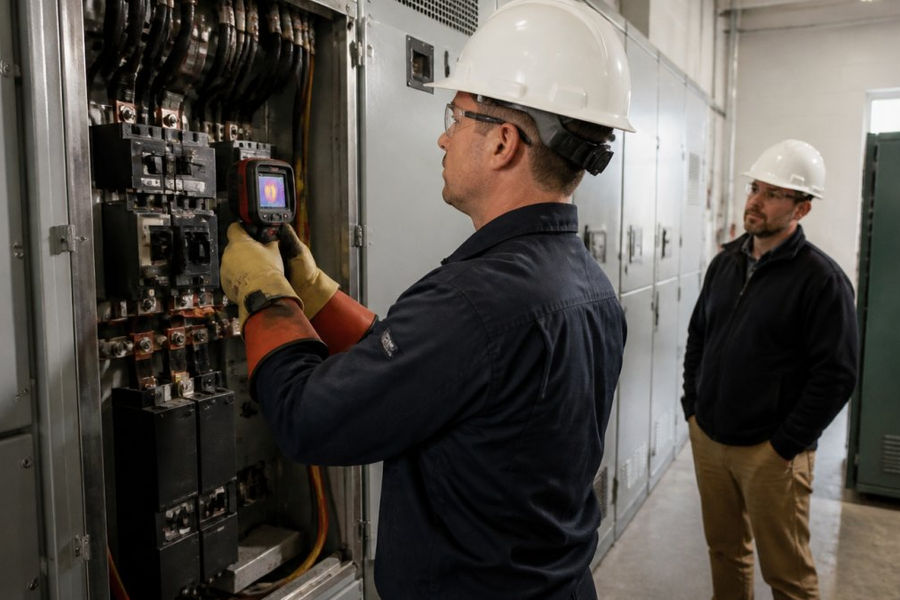
Visual inspection of enclosures for rust, moisture, and physical damage
Thermal imaging to find hot spots before they fail
Torque checks on accessible lugs and connections
Loose connections are the quiet killer here. They build heat slowly, and by the time you notice, the damage is already done. A connection that is merely snug at installation can loosen over years of thermal cycling, raising resistance and temperature until insulation degrades or a breaker fails to trip.
What Owners Can Observe vs. What Requires a License
The boundary matters as much as the task list.
Everything that requires opening a panel, removing a cover, or touching a conductor belongs to a licensed electrician. That includes torque checks, breaker exercise, insulation resistance testing, and any work inside switchgear or transformer enclosures. In most jurisdictions, that work also requires a permit, and energized work requires lockout/tagout procedures and appropriate personal protective equipment.
Thermal Imaging and Electrical Testing
Thermal imaging finds problems the eye cannot see. An infrared scan reveals overheating connections, overloaded circuits, and failing components while the system is still running.
Electrical testing goes deeper. Technicians measure insulation resistance, verify grounding and bonding, and test protective devices to confirm they will actually trip when needed.
The National Fire Protection Association publishes the standards that govern much of this work, including NFPA 70B for electrical equipment maintenance and NFPA 70E for electrical safety in the workplace.
Transformers and Switchgear: What to Track
Transformers and switchgear age differently from panels. Track installation dates, nameplate ratings, and any history of oil testing or insulation resistance results. Transformers that are loaded near capacity run hotter and age faster; a common pattern is to review loading annually and plan replacement before failure forces the decision. Switchgear needs periodic cleaning, torque verification, and inspection of barriers and shutters, because dust and moisture accelerate breakdown in compartments that are rarely opened.
Key Takeaway For panels, switchgear, and transformers, the owner's job is observation and documentation; the electrician's job is testing and service. Keeping that line clear protects your people and preserves the audit trail.
Building an Electrical Maintenance Schedule for Commercial Buildings
An electrical maintenance schedule for commercial buildings turns your checklist into a calendar. Start with the frequency table above, then layer in three things: criticality, downtime windows, and vendor availability.
Prioritizing by Criticality and Planning Downtime
Not every circuit deserves equal attention. Map your equipment by what happens if it fails.
Tier 1: Life safety and emergency systems. Failure is unacceptable.
Tier 2: Revenue-critical loads like refrigeration, POS, and servers.
Tier 3: Comfort and convenience loads.
Schedule Tier 1 work first, and never during business hours. Then plan Tier 2 work around your slowest periods.
If downtime is a real concern for your property type, our guide on preventing electrical downtime in retail stores walks through backup power and scheduling options.
Using an Electrical Maintenance Log Template for Audit Readiness
An electrical maintenance log is only useful if it survives an audit. That means dates, names, findings, and corrective actions, all in one place.
Build your log with these columns:
Field | What to Record |
Date and time | When the check happened |
Equipment ID | Panel or asset tag |
Task performed | What was checked or serviced |
Findings | What was found, in plain language |
Corrective action | What was done and by whom |
Technician name and license | Who signed off |
Next due date | When it repeats |
If a finding can't be fixed immediately, log it as an open item with an owner and a target date. Auditors look for that follow-through.
For a fuller method, see our step-by-step guide to verifying electrical code compliance.
Where Safe Visual Checks End and Licensed Electrical Work Begins
The line is simple: if it requires opening a panel, removing a cover, or touching a conductor, it belongs to a licensed electrician. No exceptions.
Owners can look, listen, smell, and document. Everything else needs a license, and in most cases a permit.
Why be strict about this? Because the Occupational Safety and Health Administration treats energized electrical work as a serious hazard, and lockout/tagout procedures exist for good reason.
If you're unsure whether a task crosses the line, it does. Call a professional.
When you're ready to bring in a licensed team, you can book commercial electrical inspection services and get a clear scope before anyone touches your equipment.
Budgeting and Lifecycle Planning for Commercial Electrical Maintenance
Electrical maintenance is cheaper as a planned expense than an emergency one. Budget for it the way you budget for roof replacement: as a known future cost, not a surprise.
Plan around three buckets:
Routine maintenance: scheduled inspections and testing
Corrective repairs: fixing what inspections find
Capital replacement: aging panels, switchgear, and transformers
Equipment has a service life. Panels and switchgear typically last decades, but transformers and older breakers age out sooner. Track installation dates and plan replacements before failure forces your hand.
Pricing for commercial electrical work depends on scope, equipment condition, and access, so we quote each project individually. Our breakdown of commercial electrical service pricing factors explains what drives those numbers.
Key Takeaway The cheapest electrical program is the one that catches problems early. Every dollar spent on preventive inspection is a dollar not spent on emergency repairs and lost business hours.
Conclusion
The hardest part of commercial electrical maintenance isn't the checklist itself. It's keeping the schedule when operations get busy and nothing appears to be failing.
That's exactly where a partner helps. Elecstroman Electric provides code-compliant electrical services with strict adherence to technical specifications and security protocols, including federal and military standard compliance for critical facilities.
Request a quote from Elecstroman Electric and get a maintenance plan built around your building, not a generic template.
Frequently Asked Questions
What should be included in a commercial electrical maintenance checklist?
A workable checklist covers eight areas: panel and breaker condition, wiring and terminations, overheating and fire-risk checks, switchgear and transformers, grounding and bonding, emergency and backup power systems, safety procedures including lockout/tagout, and documentation. Each item should name who performs it, how often, and what result counts as a pass. Keep the owner-performed items visual only, and route anything involving opening enclosures, testing live circuits, or torqueing connections to a licensed electrician.
How often should commercial electrical systems be inspected?
Split the work by frequency. Monthly, staff walk the building looking for heat, odor, discoloration, tripped breakers, and damaged cords. Quarterly, a licensed electrician inspects panels, checks terminations, and runs infrared scans on loaded equipment. Annually, schedule full testing of switchgear, protective devices, grounding and bonding systems, plus emergency and backup power under load. Adjust intervals for criticality: a data room or food service kitchen warrants tighter cycles than a storage area with light loads.
What electrical maintenance can business owners safely perform?
Owners and trained staff can handle visual inspection only: looking for scorch marks, listening for buzzing, smelling burning insulation, checking that panel doors close and clearances stay unobstructed, confirming breaker labels match reality, testing GFCI receptacles at the button, and logging everything. Anything past that, including removing panel covers, tightening lugs, testing with a meter, or resetting a breaker that trips repeatedly, belongs to a licensed electrician under lockout/tagout.
What records should businesses keep after electrical maintenance?
Keep four record types: the dated checklist showing what was inspected and by whom, infrared scan reports with images and temperature readings, corrective-action logs tracking defects from discovery to closure, and equipment records showing ratings, installation dates, and test results. Store them for at least the life of the equipment. These records prove due diligence during insurance reviews, fire inspections, and audits, and they turn a vague memory of a problem into a documented repair history.
Request a Quote
Add elecstromancontractors.com as a preferred source on Google →

Comments